Treatment Guide
Ultherapy in Seoul versus Japan-Sold MFU Platforms — A Patient-Side Comparison
How Merz Aesthetics Ultherapy as run in Korean clinics actually differs from the Doublo and Daeyang-style micro-focused ultrasound platforms more commonly encountered in Japanese clinics, with the regulatory and clinical-evidence framing an international patient needs.
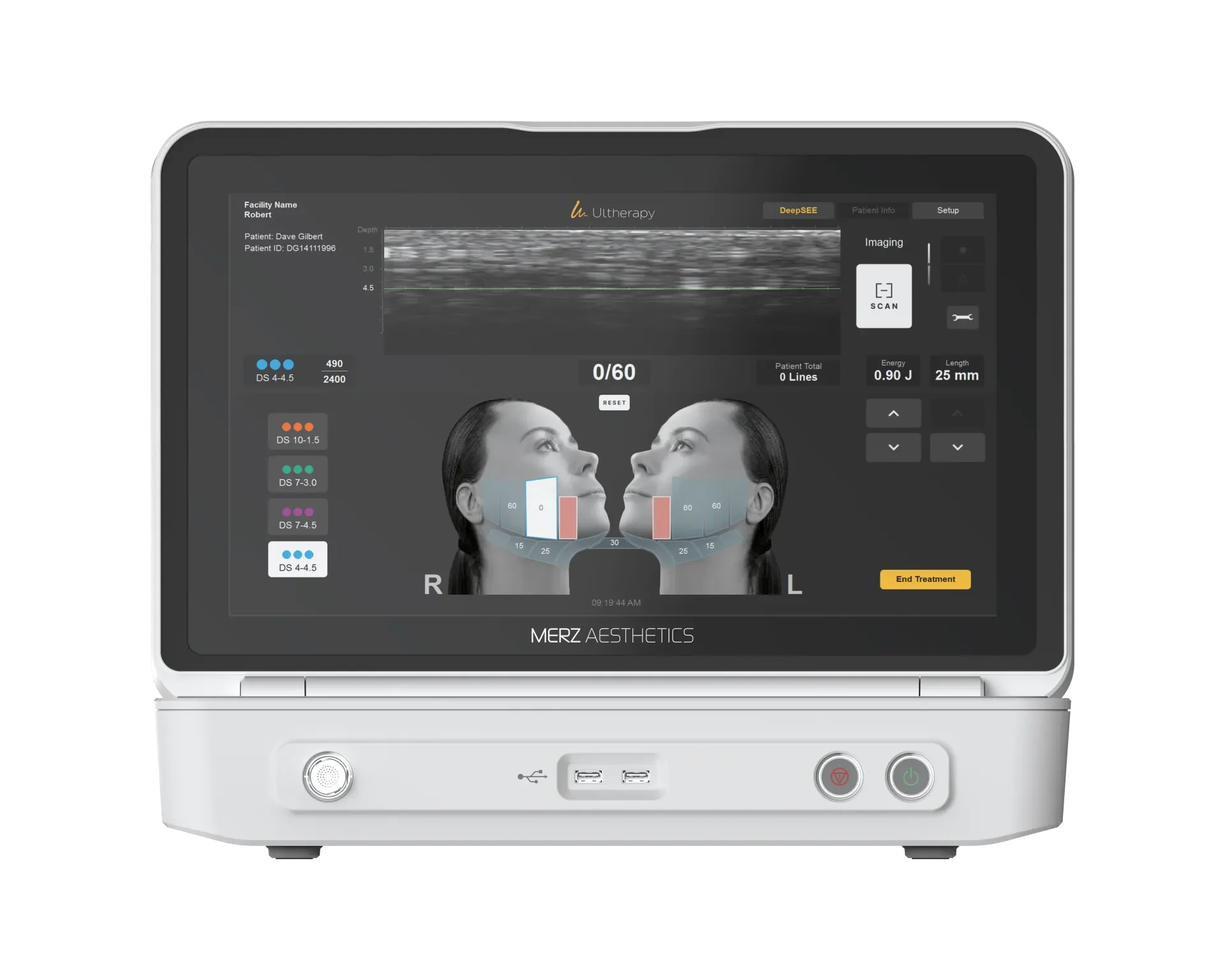
An international patient deciding between Seoul and Tokyo for a micro-focused ultrasound lifting protocol is almost always comparing two different categories of platform rather than two pricing tiers of the same platform. In Seoul the dominant platform across the senior clinic clusters is Merz Aesthetics Ultherapy, currently in its PRIME generation, with a clinical-evidence and regulatory trail traceable to the original FDA submissions in the early 2010s. In Tokyo the more frequently encountered MFU platforms include Doublo (a Korean-manufactured platform sold heavily into Japan), Daeyang-style systems, and a broader category of micro-focused ultrasound devices that carry PMDA authorisation. The platforms share an underlying mechanism — thermal coagulation at the SMAS layer — but they differ meaningfully in handpiece engineering, real-time imaging capability, and clinical-evidence depth. This page is the Taiwanese first-person comparison, written from four Seoul trips and three Tokyo trips. Authority anchors: the Merz Aesthetics provider locator for Ultherapy authentication, MFDS for Korean device authorisation, PMDA for Japanese device authorisation, and KHIDI for the medical-tourism framework.
What 'MFU' actually refers to — the mechanism shared across platforms
Micro-focused ultrasound, or MFU, is the device-category term for ultrasound platforms that deliver focused thermal energy to specific tissue depths to trigger localised coagulation and downstream collagen remodelling. The shared mechanism across Ultherapy, Doublo, Daeyang-style systems, and the broader Japanese MFU category is the same: focused ultrasound energy delivered at depths corresponding to the dermis, subdermal tissue, and the SMAS, with thermal coagulation generating a wound-healing response that produces measurable lift over a three-to-six-month window. The platforms differ in handpiece design, imaging capability, depth precision, and clinical-evidence depth — not in fundamental mechanism. A patient told that one MFU platform 'works completely differently' from another is being given marketing framing rather than clinical fact; the differences live in engineering, evidence, and physician experience.
Why platform-level differences still matter even with shared mechanism
Shared mechanism does not mean interchangeable outcomes. Handpiece engineering determines how evenly thermal energy is distributed at target depth, which determines both efficacy and tolerability. Real-time imaging capability determines whether the treating physician can verify she is hitting the SMAS layer — patient anatomy varies, and depth verification matters. Clinical-evidence depth determines what a physician knows about long-term outcomes and edge cases. These differences are the substantive reasons platform selection matters.
Ultherapy in Seoul — the clinical-evidence and regulatory trail
Merz Aesthetics Ultherapy is the longest-running MFU platform with cleared regulatory submissions, originating from the original FDA approvals in the early 2010s and now in its PRIME generation following the global rollout across 2023 and 2024. In Korea, Ultherapy authorisation runs through the Ministry of Food and Drug Safety (MFDS), which maintains the device-approval and post-market-surveillance infrastructure for aesthetic medical devices. The senior Korean clinic clusters that handle returning international patients — Cheongdam, Apgujeong, the Gangnam Station axis — have largely transitioned to PRIME, with the Merz Aesthetics provider locator at ulthera.com as the authoritative reference. The clinical-evidence trail behind Ultherapy is the deepest in the MFU category by some margin; the platform has been studied across multiple anatomical zones, multiple patient populations, and a long enough timeline to support meaningful long-term outcome data. The Korean Society of Dermatology (KSD) and the broader Korean aesthetic-medicine community have published clinical experience across the entire DeepSEE-to-PRIME transition. For an international patient, the practical implication is that Ultherapy in Seoul carries the most extensive evidence trail of any MFU platform available globally.
Doublo and Daeyang-style platforms in Japan — what is actually being sold
Doublo is a Korean-manufactured MFU platform that has historically been sold into the Japanese market at meaningful volume. The platform operates on the same micro-focused ultrasound mechanism as Ultherapy, with handpieces designed for SMAS-depth delivery, and carries device authorisation under PMDA in Japan. The Daeyang category is a broader term covering Korean-manufactured MFU platforms — Doublo is the most widely recognised example, but the category includes other manufacturer-named systems sold into Japan and other Asian markets. The practical pattern in Tokyo: many Japanese clinics that offer MFU lifting list 'HIFU' or 'ultrasound lifting' on the consultation page without specifying which platform, and follow up with Doublo or another Korean-manufactured MFU system on the treatment-day setup. Better Japanese clinics specify the platform clearly. The clinical-evidence trail behind Doublo and Daeyang-style platforms is meaningfully shorter than the Ultherapy trail; the platforms are real and the authorisations are real, but the long-term outcome literature is less extensive.
How to verify platform identity in Tokyo before booking
The verification protocol for Tokyo is structurally similar to the Seoul protocol but anchored on different authoritative channels. Ask the clinic in writing which platform the quoted protocol uses (Ultherapy, Doublo, a named Daeyang-category system). Verify platform authorisation through PMDA where applicable. Ask whether the platform's manufacturer maintains a provider locator equivalent to ulthera.com — for Doublo this is more limited than for Ultherapy. A Tokyo clinic that answers clearly is operating at the same editorial transparency standard as a senior Seoul clinic; one that hedges is the same warning sign in either market.
Clinical-evidence depth — the substantive difference
If there is one substantive difference an international patient should weight most heavily, it is clinical-evidence depth. Ultherapy carries the most extensive published clinical-evidence trail in the MFU category by some margin, accumulated across more than a decade of physician-led studies, manufacturer-sponsored investigations, and real-world experience across multiple regulatory jurisdictions. Doublo and Daeyang-category platforms carry meaningful but shorter evidence trails. This is not a statement that the Korean-manufactured platforms do not work — they do, on the same mechanism, with real clinical results. It is a statement that the treating physician, in any country, has more accumulated knowledge of edge cases, contraindications, and long-term outcomes when using Ultherapy than when using a platform with a shorter evidence trail. For a one-trip international patient making a substantial out-of-pocket commitment, the evidence-trail differential is a meaningful input.
What the evidence trail does not tell you
Evidence depth does not capture every aspect of patient experience. A Doublo treatment by an experienced Tokyo dermatologist who has performed thousands of MFU sessions is plausibly a better experience than an Ultherapy treatment by a junior practitioner at an underinvested clinic. Platform selection and physician selection are independent variables. Platform selection sets the floor on what is technically possible; physician selection determines whether the actual treatment lives up to that floor.
Regulatory framing — MFDS, PMDA, and the international-patient implications
An international patient deciding between Seoul and Tokyo is also implicitly choosing between two regulatory frameworks. MFDS maintains the aesthetic medical-device authorisation and post-market-surveillance infrastructure in Korea, and KHIDI maintains the medical-tourism facilitator registration and oversight framework that governs how international patients are channeled into Korean treatment. Our facilitator registration is KHIDI A-2026-04-02-06873. In Japan, the Pharmaceuticals and Medical Devices Agency (PMDA) is the equivalent regulator for medical-device authorisation, but the Japanese medical-tourism framework is less consolidated — there is no single Japanese equivalent of KHIDI registration for facilitators, and consumer-protection infrastructure for international patients varies more by clinic. The practical implications: regulatory protection in either country is real, but the institutional pathway differs. For a patient prioritising consolidated institutional oversight, the Korean framework with KHIDI-registered facilitation is more transparent end to end; for a patient with strong existing Tokyo physician relationships, the Japanese framework works fine on a per-clinic basis but provides less consolidated facilitation oversight.
Practical recommendation for the international patient making the choice
There is no universally correct answer to Seoul versus Tokyo for an MFU lifting protocol. The recommendation I would offer to a Taiwanese, Hong Kong, mainland Chinese, or Southeast Asian patient: if your priority is the deepest clinical-evidence trail, the broadest physician-side experience base, and the most extensive set of senior clinics running the current generation of the dominant platform, Seoul with Ultherapy PRIME at a senior Cheongdam or Apgujeong practice is the most defensible choice. If your priority is proximity to Tokyo, an established physician relationship in Tokyo, or a preference for the Japanese medical-tourism experience, a Tokyo clinic offering Doublo or a comparable platform at a senior practice is a reasonable alternative — with the caveat that the evidence trail is shorter and the verification path is more clinic-by-clinic. The framework is not Korea-good Japan-bad; it is consolidated-framework-Korea versus per-clinic-framework-Japan, with substantive evidence-trail differences favouring Ultherapy as the platform itself.
What I would not recommend in either country
I would not recommend an MFU treatment at any clinic in either country where the platform identity is not specified in writing before deposit, the operator's licensure cannot be cross-verified through the relevant regulator, or the consultation declines to break down shot count by anatomical zone. These three warning signs apply identically in Seoul and Tokyo, in any platform category, and at any price tier. The editorial discipline is portable across both countries; the platforms differ, the verification standard does not.
Frequently asked questions
Is Ultherapy actually clinically superior to Japan-sold MFU platforms, or is that just marketing?
The mechanism is the same across MFU platforms — focused ultrasound thermal coagulation at SMAS depth. Where Ultherapy carries a substantive advantage is clinical-evidence trail depth, which is the most extensive in the MFU category by some margin, and manufacturer-side clinical-support infrastructure. The differences are real engineering and evidence differences rather than mechanism differences. Doublo and Daeyang-category platforms also work; the evidence trail behind them is meaningfully shorter.
Can I get Ultherapy in Tokyo, or is it Seoul only?
Ultherapy is available globally including in select Tokyo clinics; the Merz Aesthetics provider locator at ulthera.com lists authorised providers in Japan as well as Korea. The pattern in Tokyo is that Doublo and other Korean-manufactured MFU platforms are more commonly encountered than Ultherapy at the consultation level, but authorised Ultherapy providers exist. Verify on the locator before assuming.
Which regulator authorises Ultherapy in Korea and Doublo in Japan?
In Korea, the Ministry of Food and Drug Safety (MFDS) maintains the aesthetic medical-device authorisation infrastructure for Ultherapy and other platforms. In Japan, the Pharmaceuticals and Medical Devices Agency (PMDA) maintains the equivalent role for Doublo, Daeyang-category systems, and other MFU platforms sold in Japan. Both are credible regulators with active post-market-surveillance frameworks.
How does KHIDI registration affect my decision between Seoul and Tokyo?
Korea Health Industry Development Institute (KHIDI) maintains the medical-tourism facilitator registration and oversight framework in Korea, providing consolidated institutional oversight of international-patient channelling. Japan does not have a directly equivalent consolidated framework. For international patients prioritising end-to-end institutional transparency, KHIDI registration is meaningful; for patients with strong existing Tokyo physician relationships, the per-clinic Japanese framework is also workable. Our HEIM GLOBAL facilitator registration is KHIDI A-2026-04-02-06873.
Is the price difference between Seoul Ultherapy and Tokyo Doublo a useful comparison?
Not directly. The two protocols use different platforms with different clinical-evidence trails and different generation positions; price comparison is not platform-equivalent. A more useful comparison is Seoul Ultherapy PRIME at a senior cluster versus Tokyo Ultherapy at an authorised provider — the platform is held constant and only the country-and-cluster variables move. Direct price comparison across different MFU platforms is structurally misleading.
Should I prioritise platform or physician when choosing between countries?
Both. Platform selection sets the technical floor on what is possible — the device, generation, evidence depth, and manufacturer support. Physician selection determines whether the actual treatment achieves that floor — experience, depth verification skill, anatomical judgement. A senior physician on a shorter-evidence-trail platform may deliver better patient experience than a junior physician on Ultherapy. The framework is not platform-or-physician but platform-and-physician.
What are the warning signs of an underqualified MFU clinic, regardless of country?
Three warning signs apply identically in Seoul and Tokyo: platform identity not specified in writing before deposit, operator licensure not cross-verifiable through the relevant regulator (MFDS for Korea, PMDA for Japan), and consultation declining to break down shot count by anatomical zone. Any of these three is a deposit-caution signal in either country and at any price tier.
How do I verify a Tokyo clinic's MFU platform before flying?
Ask in writing which platform the quoted protocol uses (Ultherapy, Doublo, a named Daeyang-category system). Verify platform authorisation through PMDA where applicable. For Ultherapy specifically, cross-check the clinic listing on the Merz Aesthetics provider locator at ulthera.com. Request shot count broken down by zone and confirm the treating physician personally performs the treatment. The four-question verification protocol from the Seoul side translates directly to Tokyo.